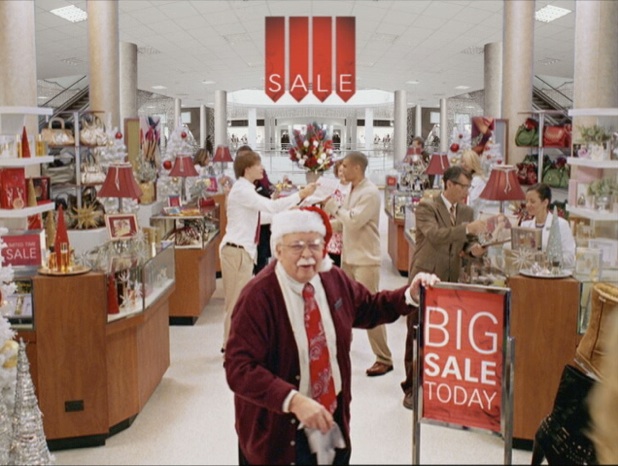
Several years ago I appeared in several television commercials. Most were local, one was regional, and one infomercial went international. Then local commercial shoots dried up. Most of the commercials broadcast in the Des Moines market were shot in Minneapolis where there’s a huge pool of actors. I had a few auditions but no bookings. I decided my acting career was over.
When I landed a featured role in The Experiment this summer, the word spread that I was back in business. Local agents and casting directors assured me that my type was relatively rare and that they would be calling me for auditions. I joked to Linda. “Eighty-three year old actors who can remember their lines are hard to find.”
On October 9 I received an e-mail from Deb Copeland asking if I wanted to audition for the Gordman’s holiday commercial, “Shop ‘til You’re Blocked.” I thought it was probably local and would pay little, but I wanted to keep my acting career going. It had come to a screeching halt when Governor Chet Culver closed down the Iowa tax incentive program. I asked myself, if feature films weren’t casting, why not act in commercials until they got that mess straightened out?
I received the text of the commercial via e-mail. I was auditioning for the role of “Greeter.” Linda and I had always joked that if we ever got into financial difficulties, I could always become a greeter at Walmart.
I had the first line:
(greeter, overly peppy):
WELCOME, SHOPPER!
I went over my two-word line again and again. Before I retired from Drake I taught courses in acting for the camera, auditioning in all medias, and film appreciation. Before I taught those courses, I had appeared on film, television, and short and long films. I learned how to act on camera by practical experience plus a lot of film viewing and reading of film theory. Above all, I knew Michael Caine’s wonderful video course in film acting.
Over the many years I taught those courses, I constantly checked with theatre alums who were out in the market and working. I even went on auditions in LA with a former student and with a professional actor in Athens, Greece. It was the same drill in these widely separated markets.
I knew that in an audition you made decisions. I learned it didn’t matter if your decision was off the mark, but it did matter if you didn’t adjust to direction if they wanted you to do something else after your first take. Actors who won’t – or can’t – work and adjust with directors soon get a bad name in the business. With that in mind, I prepared to attack those two words in as many ways as I could invent. In this age of digital cameras, audition directors do many takes. They even encourage the actor to do his or her own thing.
On October 13 I arrived at the Screenscape Studios in West Des Moines with my headshot and resume in hand. Linda and I had discussed what I should wear beyond what was called for in the script. Greeters were always older men so I wore dark slacks, a plain colored grey shirt, a bow tie, and a sweater. I wanted to be look like a cliché of an old guy doing part time work. Linda came up with the idea for me to wear a Santa Claus hat. It was the right choice. While it was not mentioned in the script, it ended up in the commercial. We had covered every eventuality. I wanted no wardrobe malfunctions, no surprises when I auditioned. The unexpected breaks one’s concentration, and a loss of focus can blow an audition.
I had been walking with a cane since my operation at the Mayo Clinic on September 2. I checked. I was mobile without it. No cane. The Greeter I was playing needed no sympathy. I also considered how I might handle a day of shooting. I thought, hey, I only have two words and some business? I’ll be in and out in an hour or two.
Since I was not yet able to drive, Linda agreed to take me to the audition. When we arrived at Screenscape’s studios, we filled out the usual paper work and were ushered into a vast studio. A cameraman/director waited. I walked in front of a large white screen and did my two words. The Greeter was supposed to be too enthusiastic. In fact he would be overwhelming the shopper, a young woman I had to imagine. The cameraman/director asked me to look disappointed when the imagined shopper walked by me. Then I suggested that I glare at her when she ignored me and walked on.
The director asked me not to be so aggressive with the camera. In my first two or three takes I moved toward it. For the rest of the takes I used my impulse to press the shopper to concentrate my energy. Energy contained can have its own power. I did the two lines and actions several times, each with a slight variation. I simplified and focused. I eliminated extraneous gesture. These could be on the edge the frame and upstage what I was doing above my shoulders. When I was asked to change, I did. I even did it sinister once. After shooting more than a dozen takes, it was a wrap. I was in and out of the audition in less than half-an-hour.
As a director who has worked on stage and television, I knew that casting involved a lot of decisions. First, when a lot of people audition, type plays an important part in casting. In fact, sometimes type takes precedence over acting ability. I had long ago learned that not being cast was not a rejection of me as a person. They just wanted something different. However, in all of those years, I had been cast in all but one audition I went to. Why? First, I didn’t audition for something I could not do or was not fitted for. Second, I have always been a good sight-reader. I learned that when I did radio drama during my master’s studies at Penn State and when I was a faculty member at Glenville State College. At Glenville I had to write, devise, and direct weekly 15-minute radio programs and monthly television programs along with a heavy course and production load.
I had no immediate response to my audition, but on October 20 Deb sent me an e-mail. I was cast! The shoot would be from 8 am to 5 pm on October 27. Nine hours! How could they take nine hours to shoot my two lines? Surely I would be home by noon.
The pay was much more than I expected since it would be a regional commercial that would be shown in 17 states. Some mundane business had to be taken care of before I went to the shoot. Deb needed my measurements for costuming and other personal information. Some of my costuming would be furnished at the shoot.
Linda drove me to the shoot. As she did with The Experiment, she brought a sampling of my clothing – and that Santa Claus hat, too. Even though Linda was working on a huge deadline for her music and had gotten horribly behind with her schedule due to our medical travels, she decided to stay with me for a while just in case anything else was needed. We were very glad that she stayed since once again she helped save the day. She also made sure my cell phone was charged and ready in case I would have to call her for any reason once she did leave. She did not intend on staying with me during the entire shoot, and was looking forward to spending most of a day at home working on her score.
We arrived half an hour early. There was a greenroom for actors and crew.
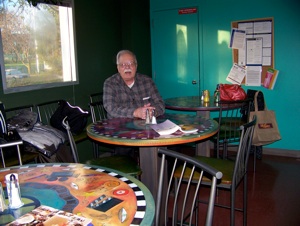
Craft services had set up a breakfast for the cast. Since I had breakfast at home, I settled for coffee and a donut. The costumer came in with my clothing. The shirt she had gotten had a pattern that would “strobe.” Linda had a plain light brown shirt that fitted the bill. Their Santa Claus hat was tight so we used the one we usually put on a Greek mask on Linda’s grand piano in our living room. Finally I was dressed for my role. It was much like what I wore at my audition.
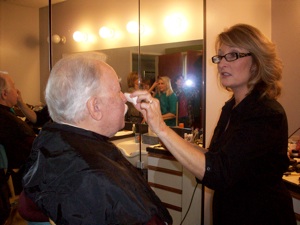
Finally I was ready for the first shot.
By now it was ten o’clock. I entered the studio where I auditioned for the first time that morning. The set was enormous. It was a very realistic department store aisle that was nearly fifty feet long. Artfully arranged displays flanked the long aisle. The studio’s walls were painted blue. Later walls and a large banner would be added digitally.
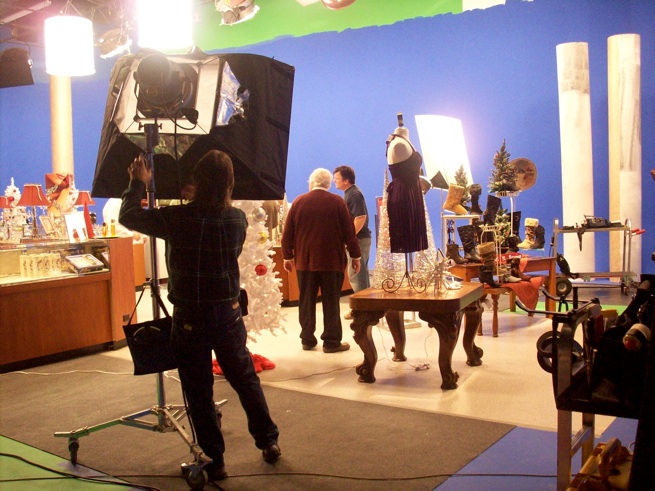
I met my director for the first time. He had worked on the crew of my very first commercial for Busby Productions years ago.
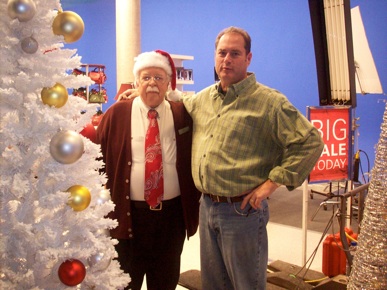
I learned that the commercial was being shot on film, not with a digital camera. There were at least 25 people in the various crews. On one side of the set there was a console where everything on camera could be viewed as it was shot. Sometimes there was immediate playback. From that the director adjusted our actions and line deliveries. Add in the elaborate set, a dozen actors, and we are talking a lot of money.
We ran through the entire 30 seconds. No cameras were running. Since I had the first line I started the shoot. We did several takes. Then it was shot over my shoulder toward the Shopper. It was shot head on, sideways, and from one end of the aisle and then the other. It was shot from above on a rigged platform.
I began to see a pattern that the director was building to for editing. In all I had only one weak take. I was not expecting to be on camera so quickly so I lost my focus and energy. Everyone else had the same problem for that take. With each shot I had to remember where my hands and gestures had gone. There was no one working on continuity, so I knew from experience that my gestures and movements had to match when I was shot from another angle. Acting of this sort required precision even as you seem spontaneous.
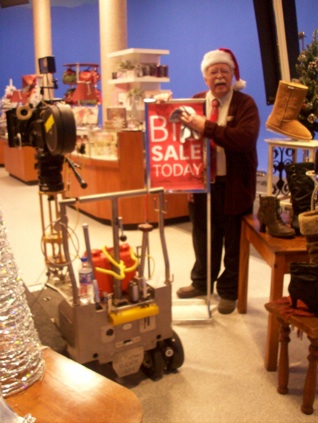
A young woman who was flown in from Chicago played the Shopper. I suspect she was the only union actor on the set. The rest of the actors were from Des Moines. We had time to chat between takes. Linda had alerted the crew that I needed to sit after each take as camera, lights, and sound prepared for the next shot. After I finished a series of shots, a crew member delivered a stool for me to sit on. As the day progressed I was pleased to find that my energy was standing up well.
Then we shot into the next scene. I had to follow the action as we all bugged the harried Shopper. Each beat was shot again and again. Each beat involved several camera set-ups. I am a great advocate of eye contact in any kind of acting. The Shopper and I had time to work on that. Her attempt to evade my overly enthusiastic greeting was fed by eye contact. In turn, she fed me with her eye contact even when she wanted to escape me.
We broke for lunch. Again craft services had set up a lavish buffet for us.
We returned to shoot to the end of the commercial beat by beat, set-up after set-up. Then we shot the entire 30 seconds in one take as the action progressed up the aisle. After that, we shot it from the opposite end of the aisle. In all, we must have shot several hundred takes.
They set tracks for a dolly shot outside the aisle and caught the action continuously as it moved through the several sequences. Again, this was shot several times.
The commercial can be seen at:
http://www.gordmans.com/Advertising/TVAdvertisements/Index.htm
It goes by quickly, but it is not difficult to see how we took nine hours to get those less than 30 seconds on screen. The cutting is crisp and tight. I can see how we spent those nine hours when I look at the commercial. I count at least 20 edits in a little less than 30 seconds. I am sure there are more that go by so quickly they are hard to count.
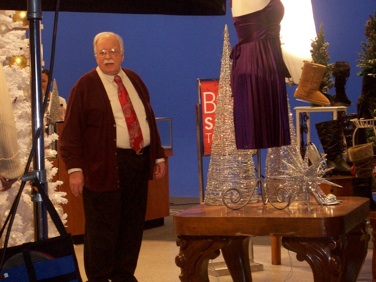
I like the movement swirl of the action I have with the Shopper as she pushes by me. Remember that a feature movie is happy to get two minutes of usable film shot in a full day that sometimes includes overtime.
Commercial – and film - acting is very different from television acting. Television uses much longer shots. Film is different from either medium. They use long master shots and then edit in medium and closer shots. Stage differs even more. When you walk on stage you can be starting an hour of continuous action. Even with a bit part you do more continuous action than you do on film and television. Commercials are a different animal.
Shooting a commercial with this quality of production has its rewards. Crews are eager to make you comfortable between takes. Many amenities are supplied, and the food is always good. To the untutored this may seem to be easy work. It isn’t. But the pay is very, very good. At least for one day. As I said in my report of being in The Experiment, I could get used to this kind of work.