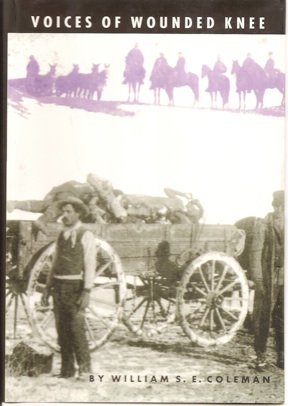
Voices of Wounded Knee
This book’s high value is in its completeness. Coleman has assembled a multitude of sources, with explanatory comments. The book is a requisite for students of the tragedy and the Indian Wars period.”
Dee Brown, author of Bury My Heart At Wounded Knee
In Voices of Wounded Knee, William S.E. Coleman brings together for the first time all of the available sources - Lakota, military, and civilian. He recreates the Ghost Dance in detail and shows how it related to the events leading up to the massacre. Using accounts of participants and observers, Coleman reconstructs the massacre moment by moment. He places contradictory accounts in direct juxtaposition, allowing the reader to decide who was telling the truth. His balanced treatment suggests that the massacre grew out of decades of broken treaties, cultural misunderstandings, power struggles between the Department of the Interior and the U.S. Army, and erroneous and inflammatory reports by irresponsible members of the press.
William S. E. Coleman is a professor emeritus of theatre at Drake University in Des Moines, Iowa. He and his wife, - the internationally acclaimed composer Linda Robbins Coleman - spent nearly thirty years gathering documents from collections in the United States and abroad to create this book.
The material is exactly what is called for - a chance for the Indians to speak about their past and the events that surrounded Wounded Knee. This is an important book.
Troy Johnson, coeditor of Red Power: The American Indians’ Fight for Freedom
Devoted research results in a remarkable book. What a film this would make!
Kevin Brownlow, author of The War, the West, and the Wilderness, British film historian and film director
On December 29, 1890, two weeks after the killing of Sitting Bull, the United States Seventh Cavalry opened fire on Miniconjou Ghost dancers near Wounded Knee Creek. Some army officials claimed that the dancers were armed and that the Ghost Dance was a call for the extermination of all whites. Many Lakotas believed that the massacre stemmed from the Seventh Cavalry 7’s enduring bitterness over Custer’s loss at the Little Big Horn fourteen years earlier
Jacket photo courtesy of the
Nebraska State Historical Society
This is the first account in which participants have been allowed to tell the story almost entirely in their own words. . . . [Coleman] has welded these accounts . . . into a riveting narrative that tells how the massacre emerged out of a long string of broken treaties, cultural mistrusts, governmental rivalries, and inflammatory press reports."—Library Journal
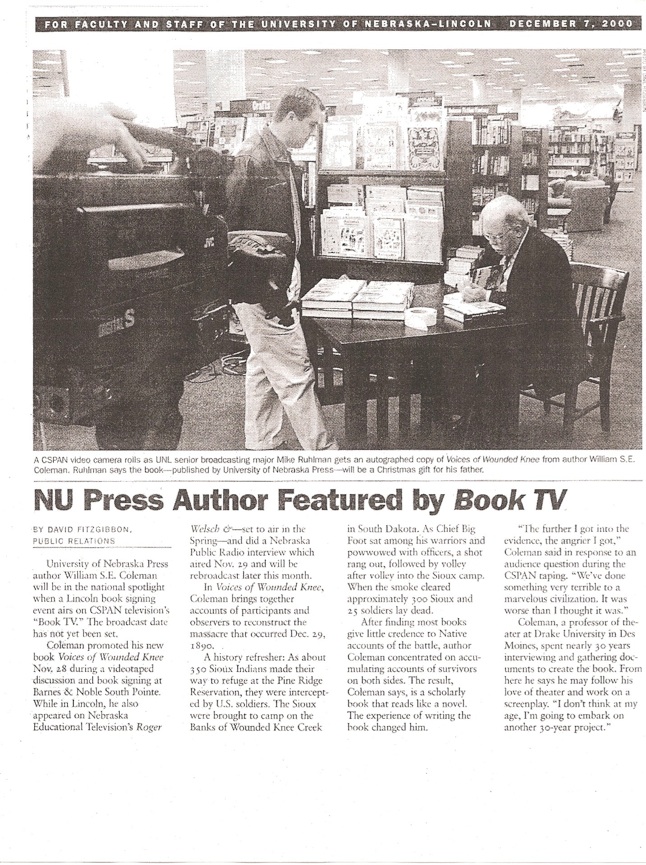
Voices of Wounded Knee is available through the University of Nebraska Press, http://nebraskapress.unl.edu/
http://www.barnesandnoble.com/
ISBN-13: 9780803264229
"This is one of the most informative books written about the unfortunate circumstances leading to the 1890 debacle at Wounded Knee. Twenty-five years in the making, it provides insights into the Ghost Dance phenomenon with its visions and beliefs in the Messiah's arrival."—Choice
"Voices of Wounded Knee reveals a basic truth about the power of collective self-delusion that is part of history. Scholars, not just Indian studies specialists, will find this book tantalizing and stimulating, and students can benefit from the ‘collective biography’ to test their abilities in synthesis and judgement. This work should be on the shelves of every library."—Gregory Gagnon, North Dakota History
I did not know then how much was ended. When I look back from this high hill of my old age, I can still see the butchered women and children lying heaped and scattered all along the crooked gulch as plain as when I saw the, with eyes still young. And I can see that something else died there in the bloody mud, and was buried in the blizzard. A people's dream died there. It was a beautiful dream.
The heartbreaking words of Black Elk and the tragic events at Wounded Knee Creek, South Dakota, in December of 1890, became widely known through Dee Brown's 1971 best-selling Bury My Heart at Wounded Knee. Less than two years later "the Knee" once more topped newspaper headlines as members of the American Indian Movement seized the trading post and Catholic Church in Wounded Knee Village, just above the hill where the victims of the 1890 massacre lay buried in a mass grave, and began a seventy-one day standoff with Federal Marshals and the National Guard. The odds in 1973 were as impossible as the first time, but the occupation demonstrated the symbolic importance of Wounded Knee for the Lakota people.
William S.E. Coleman met Ben Black Elk, son of Black Elk, in the summer of 1971. "My ancestors were desperate," the old man said with reference to the message of Short Bull, Kicking Bear, Good thunder, and other Ghost Dance visionaries. This meeting near Mount Rushmore sent Coleman off on three decades of archival research with the aim of bringing together all the available sources (though missing Will H. Spindler's account) - Lakota, military, and civilian - in Voices of Wounded Knee.
Coleman makes full use of the Ricker, Brennan and Campbell collections as well as the testimony of Short Bull. The letter of Pvt. Walter R. Crickett is another important source. Through these and numerous other sources Coleman traces the chain of events leading to the killing of Sitting Bull, the escape into the Dakota Badlands and the capture of Big Foot's band of Minniconjous. We can "hear" the tension between soldiers and Indian warriors moments before the first fatal shot and the subsequent massacre of fleeing Indians, mostly women and children.
This compilation and chronological arrangement of statements gives perspective on details as well as adding to the general understanding of the vicious circles or acceleration of the conflict. It does not, however, resolve the problem of contradicting testimonies. Methodologically, one can always raise objections to the merging of sources near in time and space with reminiscences recorded years and decades later. Compared to Coleman's achievement these reservations are minor, however. Voices of Wounded Knee is a great and important book.
Christer Lindberg, Department of Social Anthropology, Lund University, Sweden, in Great Plains Quarterly, Winter 2002
...stunning descriptions of the origins of the Ghost Dance...sets out in painful detail Chief Big Foot's capitulation to army forces who intentionally or unintentionally opened fire on unarmed Indians, killing 350 Miniconjous, most of whom were women and children....a monumental labor of love that general readers and professional historians alike will find difficult to put down.
Catherine A Corman, Harvard University, History, "Reviews of New Books," Fall, 2000
...this is the first account in which the participants have been allowed to tell the story in their own words ...he has welded these accounts into a riveting narrative...Highly recommended for academic and public libraries.
Stephen H. Peters, Northern Michigan University Library, Library Journal, September 15, 2000
Devoted research results in a remarkable book. What a film this would make!
Kevin Brownlow, author of The War, the West, and the Wilderness, British film historian and film director.
The major strength of William S.E. Coleman's impressive 434-page volume is that it presents such a variety of views regarding this still controversial battle at wounded Knee, which turned out to be the tragic climax of the Indian Wars of the late nineteenth century. Coleman, a professor of theatre at Drake University, spent almost thirty years gathering testimony from documents, letters, records, journals, newspaper clippings, and other archival sources. His focus, as the title indicates, is on the perceptions of actual participants; indeed, he has truly produced a "collective autobiography."
...a most imposing reference volume for Western historians...this well written and comprehensive book is a major contribution to the study of historical and cultural conflicts in the American west.
Robert W. Larson, professor emeritus of history at the University of Northern Colorado and author of Red Cloud: Warrior-Stateman of the Oglala Sioux. Nebraska History, 82 (Spring 2001).
...one of the most informative books written about the unfortunate circumstances leading to the 1890 debacle at Wounded Knee...Two riveting chapters contain actual observations of the massacre...appropriate to all collections.
N.C. Greenberg, Museum of Indian Arts and Culture
Choice, Vol. 38, No. 3, January, 2001
Voices of Wounded Knee has the sweep and page-turning readability of a James Michener novel, but it's all true. For the first time, Native Americans are allowed to tell their side of the story...The original approach to formatting this book is a new way of writing history. This is a major contribution to Western history and to the art of writing history.
Roger Welsch, Nebraska Public Television
This book results from a lifetime of interest and research about the December 1890 fight between the United States army and Minniconjou Ghost Dances in Dakota. In it, author and compiler William Coleman sets out to bring together all the primary accounts of the battle and the events leading directly to it. These he uses as the book's narrative basis, introducing material and connecting each part with his own prose. Indians, soldiers, agents, missionaries, reporters, and pioneers all have their say in what comes to the reader as a sort of collective autobiography. This results in a highly detailed, often day-to-day narrative by the participant. While Coleman offers no clearly-stated thesis, his emphasis is on telling the Indian side of the story whenever possible, and he achieves that goal. The dust jacket claims that by juxtaposing contradictory testimony readers will be able to decide which accounts are truthful and which are not. That rarely happens because the author's clearly stated sense of moral outrage undermines the effort. This, while the narrative presents both white and Lakota as good and bad, most of the time the whites are the villains while the Indians are the victims.
The narrative opens with the Lakotas suffering because of crop failure and federal unwillingness to abide by treaty commitments to provide food and implements. Feelings of betrayal and helplessness nearly overcame the tribal people, and when news of a new Messiah who would restore old ways and remove whites from the scene reached the Sioux in 1889 they sent a delegation to investigate. Wovoka, a Nevada Paiute, related his vision trip to the spirit world and describes a series of dances. He told the visitors that by performing these they would help bring salvation to their people. The accounts show that, while desperation drove many to take up the Ghost Dance, others scoffed or at least remained skeptical. The narrative focuses on the period from the summer of 1890 through January 1891, when the closing incidents took place.
The author presents a confused and dangerous situation, with ethnic stereotypes and hatred as central issues. The Indians feared that Americans wanted to destroy them either by starvation or through military force. Area settlers, Indian office personnel, and soldiers all feared a coming war. Newspaper reporters receive particularly harsh assessment because often they spread wild rumors rather than the actual facts of the situation. The author's views come through clearly as he ties the first person accounts into a readable and interesting narrative. Yet, at times he presents individuals in several different guises. Early in the narrative Gen. Nelson Miles is depicted as playing on public fears in order to inflate military appropriations. Then, he is accused of amassing unneeded troops in the region, when, in fact, they were ordered there by his superiors. Still later, however, Miles is characterized as the voice of restraint.
In general, the book presents a careful and thorough analysis of the December battle/massacre. The author traces the actions of individuals and groups with the honest, brave, incompetent, and venal all receiving their due. A clear chronology of events and extensive annotations help to clarify the events. Except for the strange omission of Raymond De Mallie's work on the Sioux religion and the Ghost Dance, all the significant scholarship has been consulted. Even without this, Coleman has done a fine job with the project. He success in engaging the reader in the personalities and events of the story. Any thoughtful person is likely to be angered, disgusted, or ashamed by this narrative.
Roger L. Nichols, University of Arizona, Journal of American Ethnic History, Winter 2002
...a chance for the Indians to speak about their past and the events that surrounded Wounded Knee. This is an important book.
Troy Brown, co-editor of Red Power; The American Indians' Fight for Freedom,
Coleman presents a unique and comprehensive portrait of the Wounded knee Massacre as he weaves together original and occasionally newly discovered accounts of the incident from primary source material gathered in the United States and Europe...artfully combined... Regardless of the reader's stand on the subject of Wounded Knee, general audiences and students of western history will enjoy reading this collective autobiography...
Hoofprints, Vol. 30, No. 2 (Fall-Winter 2000)
...a vivid picture of an American tragedy. Coleman proves to be a solid historian who gracefully organizes a wealth of material.
Melinda Miller, The Salt Lake Tribune, Sept. 10, 2000
Coleman brings together for the first time all the available sources....massive research...A must reader on the subject of Wounded Knee.
History Media Review, September 5, 2000
...an engrossing book as well as a depressing one - depressing because the tragedy at Wounded Knee was so pointless and unnecessary, the behavior of the U.S. military was reprehensible.
Paul Stanfield, Editorial Advisory Committee; social activist. The Torch, Vol. 74, No. 2., Winter 2000-2001.
...an important contribution to this literature.
Western History Quarterly, Vol. 32, No. 3.
Readers seeking a context in which to place the United States government's continuing struggle to deal justly with Native Americans will appreciate this unique and highly readable resource, and historians will value Coleman's meticulous endnotes and accurate rendering of primary sources...With a host of participants brought back to life, Voices of Wounded Knee provides a definitive account of the tragic event about which Black Elk, the great Sioux medicine man said, "A people's dream, a beautiful dream, died there in the bloody snow."
Montana: The Magazine of Western History, Autumn 2000
It was an alternate state of consciousness experience for me. After having been educated with the bare-bones, shellacked version of history, this was like stepping through a portal back in time and seeing the intricate, complicated, ambiguous, messy reality. The detail is stunning.
And the tragedy is in the details. Buffalo Bill and Sitting Bull are made so real, yet so larger than life. The sad failure of Bill's journey to meet with (and save) Sitting Bull was poignant and pathetic in the way real life is. And in the climactic event -- the raw humanity of the slaughterers as well as the slaughtered gives the account such a savage authenticity.
The whole thing was so real that it seemed contemporary -- race politics, self-determination vs. dependency, identity vs. assimilation.
Congratulations on an exhaustive and monumental work.
Jim Uhls, screenwriter, Fight Club
William S.E. Coleman, who is one of America's best writers to begin with, has created the definitive history of the tragedy at Wounded Knee. The consummate western researcher, Doctor Coleman has been one of the foremost experts on William F. "Buffalo Bill" Cody for several decades. His knowledge and fascination with the bridging of the wild west into the theater of the 20th century has led him on this profound, oral excavation of the events that signaled the final betrayal of the American Indian and particularly the Sioux culture. This mesmerizing project presents the actual words of the principal witnesses to the massacre of non-combatant men, women and children near Wounded Knee Creek in 1890. There has never been a truer or more accurate accounting of the events that formed the Messianic, Ghost Dance rituals of the Oglala and Lakota Sioux, which were ultimately misinterpreted by the Eurocentric, white settlers and military. Beginning with the reminiscence of Ben Black Elk in a hypnotic, 1971 interview, Coleman uses the written transcripts of the participants, observers, government employees and the Indians themselves to describe the shattered treaties, subcultural prejudices and provocative press accounts that spawned the genocide. His resources are varied and composed alongside each other in an unusually egalitarian mixture, allowing the reader to judge complicity and culpability without bias. Voices is the ultimate deconstruction of an extremely confusing and dangerous time in the United States as the home, lifestyle and spiritual essence of the first Americans all but evaporate with the final settling of the frontier. 118 years seem to vanish as the very words of those involved allow us an intimate and authentically immediate recounting unlike any ever offered. It is a masterpiece of human understanding and one of the most exciting histories I've ever read.
Jeffrey Gusfield, author, Chicago Valentines